
Opinion
Opinion: RE: Ogun East Senatorial Endorsement of Dapo Abiodun: Finally Over for Otunba Gbenga Daniel


by Abayomi Arabambi
My attention has just been drawn to an article written by Wale Onifade with the stated caption below : Ogun East Ticket, How Dapo Abiodun Is Bullying, Threatening And Manipulating His Way To A Senatorial Showdown
Ordinarily, I would never have dignify such insanely and mischievous diatribes with a response but due to its extremely divisive nature, it is only natural that I put this down.
The writer mission has exposed the attributes of someone who perhaps might be suffering from Pseudologia Fantastica . His mission was not only mischievous and dishonest but erroneous with incorrect narratives that can only be spun by unctuous, dissipated, debauched and desperate elements attempting to turn a perfectly organized APC Ogun East Stake Holder meetings where His Excellency Prince Dapo Abiodun was endorsed as the Senatorial candidate of APC in upcoming 2027 General elections into something mendacious and devious.
There is a season for politics, and then there is a season for statecraft. The two are not the same, though mischief-makers delight in blurring the line. We are entering the latter, a period when far-reaching decisions are made for the good of the state, when roads must be laid, hospitals stocked, salaries paid, and oil wells brought to life. Yet here comes an article dressed as investigation, parading as conscience, that offers nothing but hearsay, envelopes, and anonymous threats. This is not journalism. This is the politics of the poisoned well, and those who drink from it will find only thirst.
The piece titled “Ogun East Ticket: How Dapo Abiodun Is Buying, Threatening And Manipulating His Way To A Senatorial Showdown” can only be best described as mischievous politics taken too far. It deploys the grammar of exposure—sources say, multiple party sources confirm, one party chieftain said—but delivers no evidence, no named accuser, no audited trail of cash. What it offers instead is speculation served as fact, and malice dressed as vigilance. This is the political season, yes. But that is precisely why we must not play politics with everything around us. The Roman philosopher Seneca warned: “No man was ever great by imitation.” Yet this writer imitates the worst kind of muckraker, the one who throws stones and hides the sling.
Let us name what is happening. Governor Dapo Abiodun has performed creditably well in infrastructure, education, health, and aviation. The Gateway International Airport is not a rumour; it is tarmac and terminal. Two oil wells have been discovered in Ogun State, and soon the state will be counted among Nigeria’s oil-producing members. Salaries are paid as and when due. Pensions are paid. Gratuities are paid. When last did Ogun workers go on strike? When last did a ghost of unpaid wages haunt the corridors of power? The governor has turned a state into a construction site, not a conspiracy theory. Yet the article mentions none of this. Why? Because facts are boring. Envelopes sell.
The writer claims Governor Abiodun is bribing 400 persons at the Adeola Odutola Event Hall in Ijebu Ode. Four hundred names? No list. No photograph of an opened envelope. No bank statement.
The truth is that the hall held the full complements of Ogun East’s leadership: every counsellor, All Wards Chairmen, All Wards Executives, All Local Government Chairmen, All Local Governments Executives, All Serving Members National Assembly, All Serving Members State Assembly, All Past Members State and National Assembly and All Members Of The State Advisory Council
Therefore, what manner of slumber produces a dream where an entire political class sells its honour in full view of one another, with not a single dissenting voice or leaking hand? The philosopher Hannah Arendt warned: “The sad truth is that most evil is done by people who never make up their minds to be good or evil.” This writer has made up his mind to see evil where a quorum sits, and that is a mischief no election season should abide.
Chinua Achebe, that great eagle of African letters, wrote in Anthills of the Savannah: “The damage done in one year of bad politics can take ten years of good governance to repair.” This article is part of that damage. It does not seek truth; it seeks traction. It does not serve Ogun East; it serves the writer’s appetite for influence and whatever his mission was. The governor’s office had not responded as of press time, the article admits. Then why publish? Why not wait for a reply? Because waiting is honourable, and honour is not the currency here.
The most audacious paragraph accuses the governor of colliding with President Bola Tinubu. “He is calling Aso Rock’s bluff,” a senior party figure says, anonymous, of course. The Presidency has not commented, the article concedes. So the writer manufactured a collision between two leaders who have worked together to stabilise the party and the state. This is not politics. This is pantomime. The Ghanaian philosopher Kwame Gyekye reminds us: “The community is prior to the individual, not in time but in moral significance.” What moral significance does this article hold? None. It elevates one man’s rumoured ambition above the collective good of Ogun East, above the ranking Senator who has served, above the infrastructure that has been built. It asks the zone to trade its peace for a headline.
And what of the ranking Senator argument? The article insists that sacrificing a ranking Senator for a first-term freshman is self-harm. Fair point, if delivered in good faith. But this is not good faith. This is a cudgel. The same writer who weeps for senatorial seniority says nothing about the seniority of development, the seniority of road networks, the seniority of an airport that now flies, the seniority of oil wells that will soon flow. Ogun State has worn a new look. That is the ranking that matters. As Wole Soyinka wrote in The Man Died: “The man who denies the facts of his society is the man who has already sentenced himself to irrelevance.” This article denies too many facts. It sees only envelopes. It hears only whispers.
Let me say this now as later. Playing politics with everything around us—with every rumour, every anonymous whisper, every imagined slight—is the fastest way to break a state. The political season is exactly when we must hold our tongues and open our eyes. Decisions are being made for the good of the state: budgets approved, roads awarded, schools renovated, health centres equipped. If we drown these in hearsay, we lose the signal in the static. The late Kenyan philosopher John Mbiti wrote: “I am because we are, and since we are, therefore I am.” That is the philosophy of the community. But the article’s philosophy is I accuse, therefore I am. That is not African. That is adolescent.
The governor, Dapo Abiodun, has run this race and is running it still—to a gold medal, as his defenders say. That is not empty praise. That is the testimony of visible works. The airport did not build itself. The oil wells did not discover themselves. The salaries did not pay themselves. If opponents wish to slog it out, let them bring their own performance index. Let them show their own roads, their own schools, their own paid pensions. But do not bring envelopes without evidence. Do not bring threats without names. Do not bring anonymous chieftains who speak only in shadows.
The article ends with theatrical gravity: “The real verdict on who enters the Red Chamber will not be delivered in an envelope at the Adeola Odutola Hall. It will be delivered at the ballot.” Agreed. So let us wait for the ballot. Let us stop printing indictments before investigations conclude. Let us stop calling a stakeholders’ meeting a cash-and-carry operation because we dislike the convener. The philosopher Karl Popper warned of the “conspiracy theory of society”—the idea that everything is controlled by invisible hands and brown envelopes. That is a lazy mind’s explanation for complex reality.
Ogun East deserves better. Ogun State deserves better. The political season demands vigilance, yes, but it also demands restraint. Not every gathering is a bazaar. Not every endorsement is a bribe. And not every journalist who shouts fire in a crowded theatre is a hero. Some are just arsonists with bylines.
Give honour to whom honour is due. Governor Dapo Abiodun has performed. Let his works be his witness. And let this article be remembered as what it is: a mischief dressed in a trench coat, caught in the rain without an umbrella.
Note:
I know full well that the writer and his sponsors have hired armchair human rice and beans Cashtivist, Crude analysts and gutted civil society organisations to stage a media war and protest against the Governor Prince Dapo Abiodun, Let me leave them with a small parable. There was once a village that had never seen rain in December. Every elder knew this. Every farmer planned accordingly. Then came a stranger who declared: “This year, December will flood.” He hired drummers to announce it, paid storytellers to spread it, and gathered a crowd to swear by it. But when December came, the sun burned as it always had. The villagers asked the stranger: “Why did you promise what has never happened?” He answered: “I wanted to be the first to say it.” That is your war. You want to do what has never been done in Ogun East—turn a hall of leaders into a den of thieves, turn a performing governor into a villain, turn a political season into a carnival of lies. You may hire your analysts and pay your civil society prophets. But the sun will still rise.
Dr Arabambi Abayomi (FBAU)
AJAGUNGBADE 1 Of Nigeria
State Convener
Sustainability Of Ogun & Dapo Abiodun Legacy Beyond 2027
Date: Monday April 20th ,2026
by Jubril Jamal
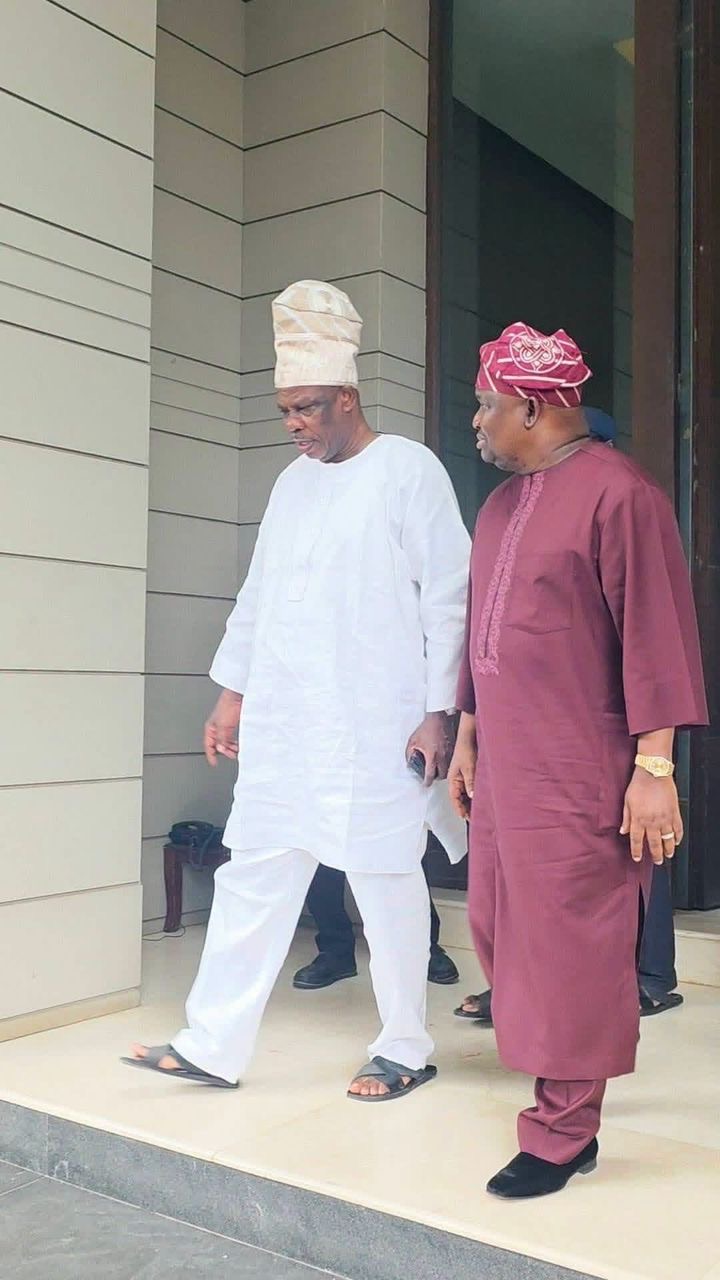
Senator Solomon Olamilekan Adeola’s consultative visit to former Ogun State Governor, Senator Ibikunle Amosun, was far more than a routine political courtesy. Coming at a crucial stage of the 2027 governorship race, the meeting signaled a deliberate effort by the APC consensus candidate to consolidate influential political blocs across Ogun State.
In a political environment where alliances often determine electoral outcomes, YAYI’s appearance at Amosun’s residence reinforced his strategy of building bridges with key stakeholders rather than deepening old divisions.
For YAYI, the significance of Amosun’s support cannot be overstated. Despite leaving office in 2019, Amosun remains one of the most formidable political figures in Ogun Central, particularly across Abeokuta North, Abeokuta South, Odeda, Obafemi-Owode, Ewekoro and Ifo.
His political structure, loyal grassroots followers and enduring influence within the APC continue to make him a major force in the state’s electoral calculations.
Winning the confidence of such a political heavyweight substantially strengthens YAYI’s chances in the senatorial district widely regarded as the battleground that could ultimately decide the governorship election.
During the convergence, YAYI maintained his now familiar message of unity, consultation and inclusive leadership. He described his statewide consultations as a mission to seek the blessings, prayers and wise counsel of respected leaders before embarking fully on his campaign across Ogun.
Rather than projecting personal ambition, he framed his governorship aspiration as a collective project aimed at repositioning Ogun State through purposeful governance, economic expansion, agricultural development and improved infrastructure. That tone of humility and inclusiveness appears designed to reassure different political interests that his administration would accommodate every section of the state.
Equally significant was Amosun’s reception of the APC flagbearer. The former governor’s willingness to receive YAYI publicly sends a strong message to his political family and supporters across Ogun Central that dialogue and party cohesion should take precedence over internal divisions. While political endorsements are measured not only by words but by subsequent mobilization, the optics of the meeting alone have strengthened perceptions that influential APC blocs are gradually rallying behind a common objective ahead of 2027.
Beyond Amosun’s political machinery, the visit also complements YAYI’s broader consultation with elder statesmen, including former President Olusegun Obasanjo. By seeking guidance from respected political leaders across ideological and factional lines, YAYI is projecting himself as a consensus builder rather than a factional candidate. The approach is intended to broaden his acceptability beyond traditional party loyalists while reinforcing his campaign’s emphasis on reconciliation, stability and statewide development.
Ultimately, the Amosun visit may prove to be one of the defining moments in the early stages of YAYI’s governorship campaign. If translated into active grassroots mobilization, it could significantly reshape the political dynamics of Ogun Central and improve his statewide electoral prospects.
More importantly, it demonstrates that in Ogun politics, securing the confidence of influential political leaders remains as important as winning the support of the electorate, and YAYI appears determined to pursue both with equal intensity.
Jubril Jamal
A Public Commentator
Gbangba, Abeokuta
Ogun State
by Chief Abiodun Lasile
I am convinced that every public speech has an audience and should reflect the realities of that audience.
The “Akara and Kulikuli” proposition may have been appropriate as a survival strategy in the remotest communities of an earlier era, but it falls far short of the aspirations of 21st-century Nigerian women. After decades of advocacy for women’s empowerment—from the Better Life Programme to the landmark Fourth World Conference on Women—our conversations should be centred on access to quality education, affordable healthcare, entrepreneurship, technology, decent jobs, and sustainable economic opportunities.
How can women struggling under the weight of inflation, rising transport costs, and declining purchasing power be inspired by suggestions that merely reinforce subsistence living, especially when such advice comes from the comfort of the nation’s highest corridors of power?
The issue is not whether selling akara or kulikuli is an honourable business—it certainly is. The concern is whether such examples represent the level of economic vision Nigerians deserve at a time of deep hardship.
Economic reforms may be reflected in statistical reports, but the true measure of success is whether ordinary citizens experience relief in their daily lives. Until the benefits are felt in the markets, on the streets, and around family dining tables, many Nigerians will continue to question whether those figures reflect their lived reality.
Leadership communication should not only acknowledge hardship; it should inspire confidence through practical, scalable solutions that restore dignity, expand opportunity, and improve the quality of life for all Nigerians.
-Abiodun Lasile DL MnbR
Orunto Baalufe of Owu Kingdom
Chairman, Association of Nigerian Authors, Ogun State
WADAA Anti-Drug Ambassador
by Dr Rotimi Rahmon
There is a saying that is gaining relevance in the political conversations of Ogun West in recent times: “One of us is better than none of us.”
At first glance, the statement may sound simple, but beneath it lies a deep political reality that many people in Ogun West will soon understand too well.
For decades, the people of Ogun West have played their part in the growth and development of Ogun State. They have contributed immensely to the economy, politics, culture, and social advancement of the state. Yet many sons and daughters of Yewaland have often felt that when major political decisions are made, their zone is usually left on the sidelines.
This feeling has not been about bitterness or entitlement. Rather, it has been about inclusion. Every community wants to feel represented. Every people desire a voice at the table where decisions affecting their future are made. It is only natural.
That is why the emergence of Senator Solomon Olamilekan Adeola, popularly known as Yayi, has generated so much interest and excitement across Ogun West. To many people, his rise represents more than the success of one individual. It symbolizes the possibility of greater political relevance for a region that has long desired a stronger presence in the leadership structure of Ogun State.
Politics is often about access and influence. When a community has a leader who commands attention and respect within the political establishment, the chances of attracting development and opportunities become stronger. Such a leader becomes a bridge between the people and government. He becomes a point of contact through which the aspirations of the people can be projected and pursued.
This is where Yayi’s story resonates with many people in Ogun West. Over the years, he has built a reputation as a grassroots politician who maintains close contact with ordinary people. Through various empowerment programmes, educational support initiatives, infrastructure projects, and constituency interventions, he has established a political presence that extends beyond campaign seasons.
Whether one agrees with his politics or not, it is difficult to ignore the fact that he has become one of the most influential political figures from Ogun West in recent times. His name is now central to discussions about the future of the state and the place of Ogun West within that future.
For many supporters, therefore, the argument is straightforward. If Ogun West has produced a leader with the experience, visibility, network, and capacity to compete at the highest level, why should the region not rally behind him? Why should people with legitimate aspirations remain divided when unity could strengthen their voice?
But this conversation should not be limited to Ogun West alone. It should also concern Ogun Central and Ogun East. The question before the state is not simply about who governs next; it is about what kind of political culture Ogun State wants to build for future generations.
Since the creation of Ogun State, leadership opportunities have largely rotated between Ogun Central and Ogun East. Both regions have produced governors and occupied the highest political office in the state at different times. Ogun West, despite its size, population, economic contributions, and loyalty to the growth of the state, is yet to occupy that position.
For this reason, many believe that supporting Ogun West at this moment is not about politics alone. It is about justice, fairness, and balance.
When one part of a state consistently feels excluded from the highest level of leadership, it creates a sense of political inequality. But when every zone is given a realistic opportunity to lead, it strengthens unity, deepens trust, and reinforces the belief that every citizen belongs.
Ogun Central and Ogun East stand to gain from such an arrangement. Supporting Ogun West would send a powerful message that Ogun State is a family where every section matters. It would demonstrate that leadership is not the exclusive preserve of any particular district but a shared responsibility among all the people of the state.
More importantly, it would help cement a tradition of political inclusiveness that future generations can build upon. Today, it may be Ogun West seeking understanding and support; tomorrow, another region may seek the same consideration. The strength of any democracy lies in its ability to accommodate all interests fairly.
The call, therefore, is not for sympathy but for partnership. It is a call for the people of Ogun Central, Ogun East, and Ogun West to see themselves as stakeholders in a common destiny. It is a call to rise above sectional interests and embrace a broader vision of equity and unity.
This is the essence of the saying, “One of us is better than none of us.”
It does not mean blind loyalty. It does not mean competence should be sacrificed for sentiment. Rather, it means that when a qualified and capable son of a region that has long waited for its turn emerges, supporting such a person becomes an investment in fairness and stability.
Today, many people in Ogun West see Yayi as that rallying point. They see him as someone who can provide the political platform through which the dreams and aspirations of the district can find expression. Whether that hope ultimately translates into greater political achievements remains to be seen, but there is no doubt that he has become a symbol of possibility.
As Ogun State approaches another defining moment in its political journey, the opportunity exists to strengthen the bonds that unite the state. By embracing fairness, encouraging inclusion, and giving every region a sense of belonging, Ogun can continue to serve as a model of peaceful and progressive politics.
That is why the message remains powerful and relevant today: One of us is better than none of us.
For many in Ogun West, it is not merely a slogan. It is a call for recognition, inclusion, and partnership. For Ogun State as a whole, it is a reminder that when every region has a seat at the table, the entire state becomes stronger.
Comrade Rotimi Rahmon Ph.D., FICA.
Osi Quarters, Ota,
Ado-Odo/Ota LG
-
 Business5 months ago
Abuja Real Estate Market shatters records with unprecedented Q1 2026 performance
-

 News11 months ago
Ogun FIBAN lauds ‘Paulo Rossi’ on birthday
-

 Politics1 year ago
The Yayi Effect and Political Leadership: A Call for Value-Driven Endorsements
-

 News1 year ago
United Premier Movement inaugurates Interim Working Committee
-

 News8 months ago
Waste Dealers Protest: Illegality Fighting Back – OGWAMA
-

 Politics1 year ago
The Yayi Effect and Political Leadership in Ogun State (Part 2)
-

 Culture12 months ago
Ayinla Egba celebrates Alake of Egbaland at 82
-

 Education11 months ago
Sixth Sense to host Children’s Reading Competition